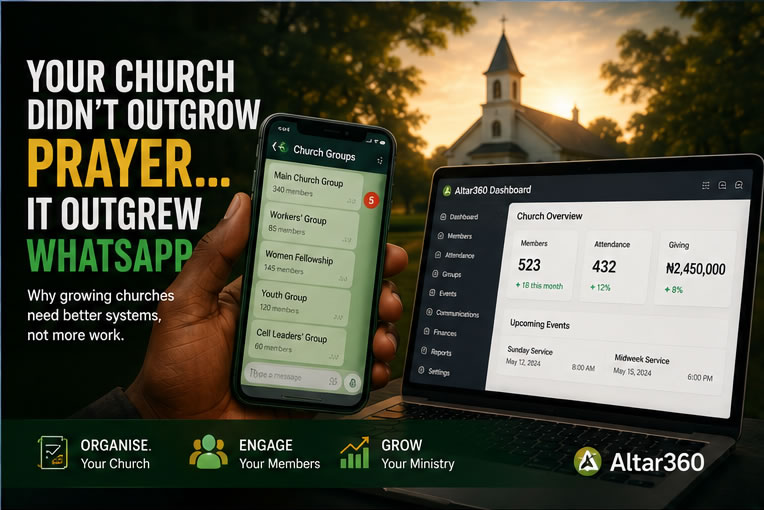

Open almost any global church management platform and you'll find the same underlying assumption, quietly baked into how the whole system works: one church, one campus, a pastor at the top, and a congregation of members below. It's a clean, simple model. It's also not how a great many African churches — especially larger, growing, or denominational ones — actually operate.
Ask a General Overseer running six branches across three cities how well that flat model fits their reality, and you'll usually get a tired laugh before the real answer.
The Structure Most Software Doesn't Know Exists
Many African churches, particularly Pentecostal and denominational ones, run on a structure that's genuinely more complex than "pastor and members": a General Overseer at the top, branch pastors running individual locations, Heads of Department managing ushering, choir, youth, women's fellowship, and dozens of other units, and workers serving under those departments — sometimes across more than one at once. Reports are meant to flow upward through that whole chain. Offerings collected at the department level need to reconcile with what a branch reports, which needs to reconcile with what the General Overseer sees.
This isn't a "nice to have" org chart feature. It's the actual operating structure of the ministry. And most church software, built for a different context — a single congregation with a pastor and a volunteer team — simply has no concept of it. You can't easily bolt a five-level reporting hierarchy onto a tool that was designed assuming there's only one level to begin with. It shows up everywhere: in how permissions work, in how reports are generated, in how giving gets attributed, in how a General Overseer is expected to find out what's happening in a branch they can't physically visit every week.
Giving Behavior That Doesn't Match the Assumptions
There's a second, quieter mismatch, and it's about money. Most global giving platforms are built around one default assumption: card or bank-debit payment is the primary path, because that's how giving typically happens in the markets those platforms were designed for.
That assumption doesn't hold the same way across much of Africa. Direct bank transfer is often the dominant, most trusted way people move money — including how they give at church. A platform that treats bank transfer as an awkward secondary option, tacked on after the "real" card flow, is solving the wrong problem for this market. It's not a matter of simply adding Naira as a currency option — currency support is easy. Designing the entire giving experience, and the trust and confirmation flow around it, assuming bank transfer comes first, is a fundamentally different product decision. It's the kind of choice that's genuinely difficult for a team who's never had to think about it, because in their market, it was never the obvious default to question.
Ministry Functions That Simply Aren't Modeled
There's a third gap, less structural but just as real: the specific pastoral and ministry functions that matter deeply in many African church contexts — marriage counselling with a formal approval process, naming ceremonies, child dedications, funeral and bereavement support, structured Bible School and Seminary programs — often don't exist as real features in platforms built primarily for a different church culture. They get treated, if at all, as a generic "event" with a date and a location, which misses what actually matters: a counselling case that needs tracking to completion, a certificate that needs to be formally issued, a follow-up chain that needs to happen after a loss in the family.
None of this is a criticism of those platforms. They were built well, for the context they were built in. The mismatch isn't a failure — it's simply what happens when software is designed around one set of assumptions and then expected to serve a very different reality.
Why This Actually Matters, Practically
It's tempting to treat all of this as detail — nice-to-have localization rather than something that changes whether a church actually benefits from the software. But consider what happens when the structure doesn't fit:
A General Overseer using a flat-structure tool either abandons proper departmental reporting altogether, or forces their real, multi-level organization into a shape the software wasn't designed for — usually resulting in exactly the kind of reporting gaps and lost visibility that make leadership harder, not easier. A finance officer working with a card-first giving tool ends up doing bank transfer reconciliation manually, outside the system, which reintroduces the very transparency problem the software was supposed to solve. A pastor trying to track a marriage counselling case in a generic "events" module loses the actual case history that matters most.
The software isn't wrong. It's just answering a different question than the one being asked.
Building From the Actual Shape of the Problem
This is the foundation Altar360 was built on — not localization added after the fact, but starting from the real organizational structure, giving behavior, and ministry functions of African churches from day one. The HOD-to-branch-to-GO reporting chain isn't an add-on; it's the backbone. Bank transfer isn't a secondary option bolted onto a card-first flow; it's the primary path, with card payment available alongside it. Marriage counselling, naming ceremonies, child dedication, funeral support, Bible School, and Seminary are real, trackable modules — not generic events with the wrong shape.
There's also a pricing philosophy that follows from taking this seriously: rather than charging per member — a model that quietly punishes a church for growing — Altar360 prices by feature tier, so a growing congregation isn't penalized for the very thing every pastor is praying for.
None of this means existing global platforms are bad tools. It means they were built to answer a different brief. African churches deserve software built to answer theirs.
See the Difference for Yourself
Altar360 is a Church Operating System built from the ground up around how African churches actually operate — structurally, financially, and pastorally. It's a full platform covering department accountability, transparent giving, visitor follow-up, branch oversight, pastoral care, and more.
You don't need to take this on faith. Altar360 offers a full 30-day free trial, no card required. Set up your church's real structure — your branches, your departments, your giving — and see what it feels like when the software already understands the shape of your ministry, instead of asking you to force it into a shape that was never yours to begin with.
Start your free 30-day trial: https://www.altar360.com