
Ask a General Overseer with more than one branch a simple question: how is your branch in [another city] actually doing right now? Not last year's snapshot, not the impression from the last time you visited — right now, this month.
Most will pause. Not because they don't care about that branch, or because the branch pastor isn't doing good work — but because the honest answer is: they mostly find out when something goes wrong, and usually later than they'd like. Attendance figures come from a phone call, if they come at all. Financial reports arrive weeks after the fact, sometimes incomplete, sometimes not at all until someone follows up. A branch that's quietly struggling — falling attendance, a department losing steam, a finance gap — can stay invisible for months, simply because there was never a direct line of sight, only distance and goodwill.
Why Distance Multiplies the Problem
A single-location church has a natural advantage most leaders don't even think about: proximity. The pastor sees the offering, hears about attendance, notices when something feels off, simply by being present. The moment a church expands to a second branch, and especially a third or fourth, that natural visibility disappears — and it's rarely replaced with anything structured. What replaces it is usually a mix of trust, occasional phone calls, and reports that depend entirely on how organized (and how available) each individual branch pastor happens to be that month.
This isn't a reflection on branch pastors' competence or commitment. Most are doing genuinely good ministry work under real pressure, often with fewer resources than the mother church. But without a shared system, every branch effectively becomes its own silo — reporting upward only as well as that branch's own discipline allows, with no consistent standard across the whole church.
The cost compounds with growth. The more branches a ministry has, the more this problem multiplies rather than resolves — and the harder it becomes for a General Overseer to actually lead the whole church, rather than just the branch they happen to be standing in.
What Real Branch Oversight Actually Looks Like
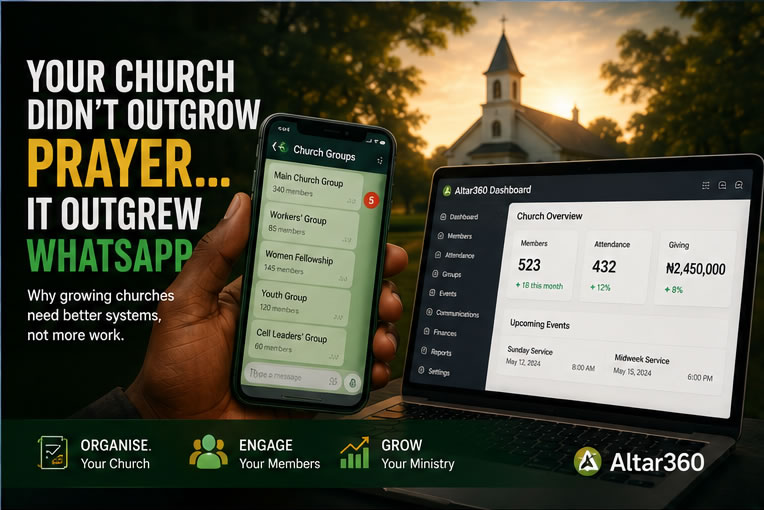
This is exactly the gap Altar360's branch management system was built to close — giving every branch, regardless of distance, a direct and structured connection to the wider church, without adding administrative burden to branch pastors who are already stretched.
Here's how it works in practice:
Every branch operates inside the same system, not a separate one. A branch isn't a disconnected outpost reporting in occasionally — it's a structured part of the same platform, with its own departments, members, attendance, and finances, all visible upward through the same chain used at the mother church.
Monthly reporting becomes a submission, not a chase. A branch pastor submits their monthly report directly into the system — attendance, financial activity, department updates — and it becomes immediately visible to the General Overseer, without a phone call, an email chain, or a reminder needing to be sent first.
A branch pastor is empowered, not just monitored. The same tools available at the mother church — department accountability, member tracking, the AI Research Assistant for sermon and study preparation — are available to branch pastors too, meaning a smaller branch without a large support staff can still operate at the same standard as the main campus.
Leadership sees the whole church, not just the part they're standing in. A General Overseer can open a dashboard and see every branch side by side — comparing attendance trends, giving patterns, and department activity — catching a struggling branch early, while there's still time to help, rather than months after the fact.
Nothing depends on a branch being "good at admin." Because the reporting structure is the same platform-wide, a branch's visibility to leadership doesn't depend on how organized that particular branch pastor happens to be — the system carries the structure, regardless of who's running the branch.
What Changes for a General Overseer
The shift here isn't just administrative convenience — it's a fundamentally different relationship with the parts of the ministry you can't physically be present in. Instead of leading by occasional visits and hopeful phone calls, a General Overseer can lead every branch with the same clarity they'd have standing in the building themselves. Problems surface while they're still small. Good work gets recognized while it's happening, not months later. And branch pastors, rather than feeling isolated and under-resourced, are working inside the same system as the rest of the church — genuinely connected, not just nominally under the same name.
Try It With Your Own Church
Altar360 is Africa's first AI-powered Church Operating System, built around how multi-branch African churches actually operate — where distance between branches shouldn't mean distance in oversight. It's part of a broader platform that also covers department accountability, transparent giving, visitor follow-up, and pastoral care.
You don't need to take this on faith. Altar360 offers a full 30-day free trial, no card required. Connect your branches, have one submit a real monthly report, and see what it feels like to actually see your whole church — not just the part you're standing in.
Start your free 30-day trial: https://www.altar360.com