
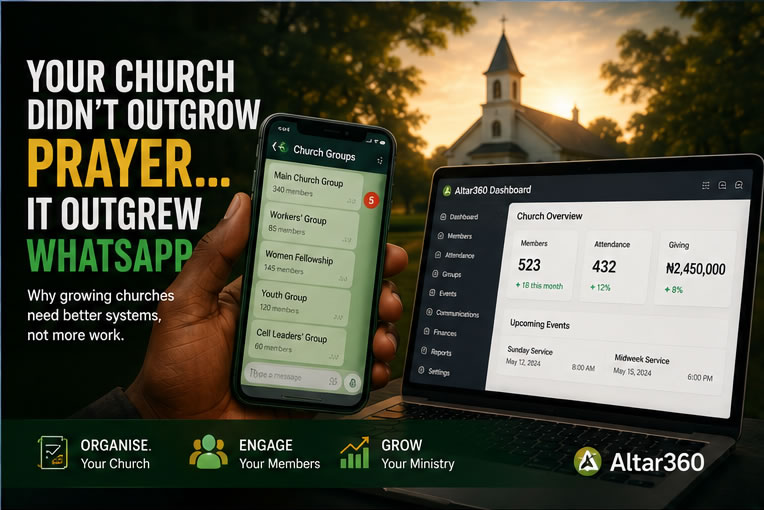
There is a moment every growing church reaches — and most pastors miss it completely.
It does not arrive with a trumpet blast or a prophetic word. It arrives quietly, on a Tuesday evening, when you are staring at a WhatsApp broadcast list of 340 people, typing an announcement for the third time this week, and wondering why Sister Amaka in Festac still says she "didn't see the message."
That moment is not a communication problem. It is a growth problem disguised as a communication problem.
Your church has grown beyond the tools you are using to run it. And the gap between where your church is and where your tools are is costing you more than you realise — in time, in members, in money, and in ministry impact.
Here are five signs that your church has officially outgrown WhatsApp groups — and what every pastor needs to understand about what comes next.
SIGN 1: YOUR ANNOUNCEMENTS HAVE BECOME A SECOND JOB
Cast your mind back to when your church had 30 members. One WhatsApp message reached everyone. Simple. Clean. Effective.
Now you have 200, 300, maybe 500 members spread across multiple groups — the main group, the workers' group, the women's fellowship group, the youth group, the cell leaders' group. You are sending the same announcement five times to five different groups. Someone in your admin team is copying and pasting the same message at 10pm on a Saturday night just to make sure everyone knows about Sunday's programme.
This is not ministry. This is data entry with a spiritual vocabulary.
The average Nigerian pastor with a growing congregation spends between 8 and 12 hours every week on church communications alone — messages, reminders, follow-ups, corrections when the first message had a wrong time, and apologies when someone was accidentally removed from the group.
That is nearly two full working days every week spent on logistics that should take 20 minutes.
Here is the question nobody asks: what would happen to your church if you used those 10 hours for pastoral care, sermon preparation, or personal discipleship instead?
Action step: Count how many hours your team spent on church communications last week. Write the number down. Then ask yourself honestly — is that how you want to spend your calling?
SIGN 2: YOU CANNOT TELL ME WHO WAS IN CHURCH LAST SUNDAY
This one is painful. But it needs to be said.
If I asked you right now to tell me exactly who attended your service last Sunday — not approximately, not "I think about 115 people came" — but exactly who was there and who was absent, could you answer?
If the honest answer is no, then your church has a problem that goes far deeper than attendance tracking. It is a shepherding problem.
In John 10:14, Jesus said: "I am the good shepherd, and I know my sheep." He did not say "I know approximately how many sheep I have." He said He knows them — by name, by condition, by location.
Mama Agbakwuru has been absent for three Sundays. Is she sick? Has she backslidden? Did someone offend her? Did she travel? Is she in hospital right now, alone, wondering if her pastor even noticed she was gone?
You cannot answer that question if your attendance system is a paper register that nobody reviews, or a headcount announced from the pulpit that gets forgotten by Monday morning.
The church that cannot track attendance cannot practice pastoral care. And the church that cannot practice pastoral care will slowly lose its members to churches that can — not because those churches have better preaching, but because their members feel seen.
Action step: Pull out your attendance records from the last three months. Identify three members who have attended fewer than 50% of services. Call them this week. Not a WhatsApp message — a phone call. What you discover will change how you think about record-keeping forever.
SIGN 3: YOUR FINANCE RECORDS WOULD NOT SURVIVE A SINGLE QUESTION
Here is a scenario that plays out in churches across Nigeria every month.
The General Overseer visits the branch pastor and asks: "How much did we receive in tithes and offerings last quarter?"
The branch pastor opens three different Excel files, two notebooks, and a WhatsApp conversation with the financial secretary, and after 20 minutes of searching says: "I will send it to you by tomorrow."
Tomorrow comes. The figure sent has a note attached: "Please note this is approximate as some records were not properly entered."
This is not exceptional. This is standard practice in the majority of Nigerian churches — including churches with thousands of members and multi-million naira monthly income.
The problem is not that your finance secretary is incompetent. The problem is that you are asking skilled, dedicated people to manage complex financial operations using tools designed for personal use.
Excel was not built for church accounting. WhatsApp was not built for financial reporting. And the consequence of using the wrong tools for a sacred responsibility is not just operational — it is spiritual.
Proverbs 27:23 says: "Be thou diligent to know the state of thy flocks, and look well to thy herds." In modern terms — know the state of your finances. Not roughly. Not approximately. Know.
Action step: Ask your finance team to produce a complete income and expense report for last month by end of day. If they cannot do it in under one hour, your financial systems need an urgent upgrade.
SIGN 4: YOUR FIRST TIMERS ARE DISAPPEARING INTO THIN AIR
This statistic will disturb you: research on church growth in West Africa consistently shows that between 60% and 80% of first-time visitors to a church never return for a second visit.
Read that again.
Of every 10 people who walk through your church doors for the first time, 6 to 8 of them will never come back.
Now think about last Sunday. How many first-timers did you have? Five? Ten? Twenty? According to the statistics, most of them will not be there next Sunday.
The tragedy is not that they left. The tragedy is that in most churches, nobody knew they had come, nobody called them during the week, nobody prayed for them by name, and nobody noticed when they did not return.
In the early church described in Acts 2, the believers devoted themselves to fellowship — 'koinonia' in the Greek, meaning intimate, participatory community. People were not just counted; they were connected.
Your first-timer follow-up system is either working or it is not. And you can measure it with one simple question: of every 10 first-timers your church received in January, how many became regular members by April?
If you cannot answer that question, you do not have a follow-up system. You have a hope.
Hope is powerful in the prayer room. In church management, hope needs to be backed by a system.
Action step: Create a WhatsApp message right now to send to your workers: "I need the names and phone numbers of every first-timer from last Sunday on my desk by Wednesday." Then track what happens when you actually call every single one of them.
SIGN 5: YOUR PASTOR IS RUNNING THE CHURCH INSTEAD OF LEADING IT
This is the most important sign of all — and the most overlooked.
There is a profound difference between running a church and leading a church. Running a church means you are managing logistics, chasing information, producing reports, resolving administrative crises, and spending your best mental energy on things that a well-designed system should handle automatically.
Leading a church means you are casting vision, making disciples, counselling the broken, studying the Word, praying without ceasing, and building the kind of spiritual community that outlives any single leader.
Most Nigerian pastors are running their churches. And the reason is not lack of ability or vision. The reason is that the administrative burden of a growing church without proper systems will consume every available hour of every available person — including the senior pastor.
When was the last time you spent an entire morning in uninterrupted prayer and Word study? When was the last time you visited a sick member without having six administrative crises waiting on your phone? When was the last time you finished a Sunday service and spent the afternoon thinking about next month's vision rather than last month's offering reconciliation?
Exodus 18 records one of the most practical moments in scripture. Moses was managing everything himself — judging every dispute, counselling every person, handling every administrative matter — from morning to evening. His father-in-law Jethro watched this for one day and said, with the directness that only a father-in-law can muster: "The thing that thou doest is not good. Thou wilt surely wear away, both thou, and this people that is with thee."
The answer was not for Moses to pray harder or fast longer. The answer was structure. Delegation. Systems.
God has not called you to burn out managing a church. He has called you to build one.
Action step: For the next seven days, write down every hour you spend on administrative tasks rather than ministry. At the end of the week, look at that list and honestly ask: "Which of these could a system do better than me?"
WHAT COMES AFTER WHATSAPP?
None of this means WhatsApp is evil or that technology replaces the Holy Spirit. WhatsApp is a brilliant tool — for conversations with friends and family, for personal communication, for community building at a basic level.
But WhatsApp was not designed to run a church. And using a personal communication tool as your church operating system is like using a bicycle to do the work of a delivery truck. The bicycle is not the problem. Using it for the wrong job is.
The churches that will define the next decade of Christianity in Africa are not the ones with the loudest sound systems or the most elaborate programmes. They are the ones that combine spiritual depth with operational excellence — churches that know their members by name and by need, that account for every naira received, that follow up every visitor, and that release their pastors to do what only a pastor can do.
That kind of church is not built on WhatsApp groups and Excel sheets.
It is built on intentional systems that serve the mission.
Ready to move beyond WhatsApp?
Start your 14-day free trial at altar360.com — no credit card required. Every module you need to manage your church is waiting for you.


