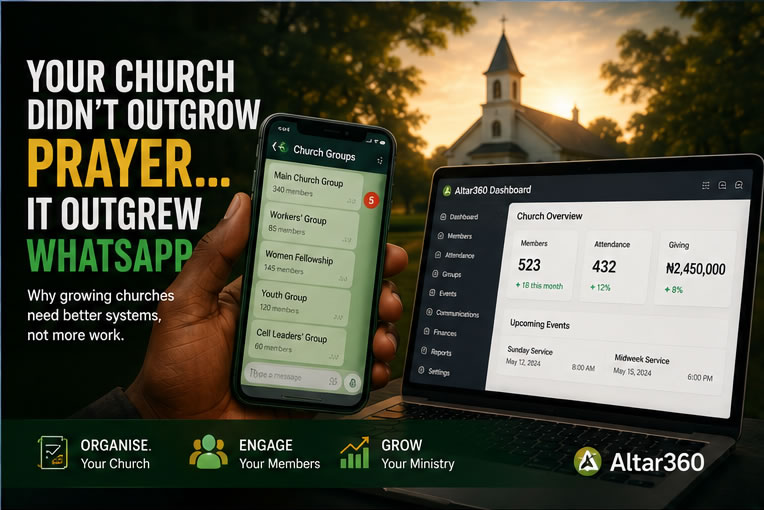

Every General Overseer has lived this moment. It's the end of the month, and you need to know what actually happened across your church's departments — how ushering went, what the youth department is up to, whether the women's fellowship met their targets. So you ask.
And then you wait.
The usher department sends something, eventually, but it's missing the offering breakdown. The youth HOD says they'll send it "by tomorrow" — tomorrow becomes next week. Someone traveled. Someone's phone got stolen and the notes were on it. By the time you've chased everyone down, three weeks have passed, and the report you finally assemble is really just a patchwork of memory, guesswork, and goodwill.
This isn't a failure of your leadership team. Most of them are diligent, committed people doing real ministry work. The failure is structural: there was never a system connecting what happens on the ground — an usher counting attendance, a department head collecting offering — to what you, as the overseer, actually need to see. Every link in that chain depends on someone remembering, someone following up, someone not being too busy that particular week.
Why This Gets Worse, Not Better, As Churches Grow
It's tempting to think this is a small-church problem, something that resolves itself once you have "proper structure." In practice, the opposite tends to happen. A small church with one pastor and a handful of volunteers can often hold everything in one person's head. A church with 30 departments, multiple branches, dozens of HODs, and hundreds of workers cannot — and that's precisely the size at which the gaps become expensive.
Consider what's actually at stake in a broken reporting chain:
- Financial exposure. If ushering offering isn't reconciled promptly against what a department reports, small discrepancies can go unnoticed for months — not necessarily due to dishonesty, but because nobody was checking the numbers against each other in real time.
- Ministry blind spots. A department that's quietly struggling — low attendance, volunteer burnout, a program that's stopped working — won't show up in a report that never arrives. Leadership finds out only when the problem is already serious.
- Erosion of trust, both ways. HODs feel like they're being chased and nagged. Overseers feel like they're always the last to know. Neither is a fair position to be in, and neither is anyone's fault — it's the absence of structure doing the damage.
What a Real Accountability Chain Looks Like
This is the exact problem Altar360's department and HOD system was built around — not as an add-on report generator, but as a structural backbone connecting every level of church operations into one continuous chain.
Here's how it actually functions:
It starts at the point of activity, not at the point of reporting. When an usher records a service — attendance, offering collected, handover details — that record doesn't sit isolated in one person's notebook. It becomes the foundation the rest of the chain builds on.
Each department has its own dashboard, scoped to what that HOD is responsible for. A youth department HOD sees youth department data — attendance, activities, their own team of workers — without needing access to (or the burden of) unrelated departments. This isn't just tidiness; it means each HOD can actually manage their own area properly instead of drowning in irrelevant information.
Reports flow upward automatically, not by request. A department's activity rolls up to the branch level, and a branch's activity rolls up to the General Overseer level, without anyone needing to manually compile, email, or "remember to send." The overseer isn't waiting for a report to be written — they're looking at a live picture that's already there.
Multi-department workers are handled honestly, with overlap warnings. In real church life, the same person often serves in more than one department — a worker might be in both the choir and the ushering team. Altar360 flags these overlaps so leadership can see when someone is stretched across multiple commitments, rather than that reality staying invisible until the person burns out or a schedule conflict blows up unexpectedly.
Nothing depends on any single person's memory or availability. If an HOD is traveling, sick, or simply forgets, the underlying activity data — attendance already recorded, offering already logged by the usher — is still there. The report isn't reconstructed from memory weeks later; it's already accurate, because it was captured at the moment it happened.
What This Changes for a General Overseer
The shift isn't just "reports arrive faster." It's a fundamentally different relationship with your own church's operations. Instead of asking "what happened this month?" and hoping for a complete answer, you're looking at what's actually happening — today, this week — across every department and every branch, without needing to personally chase a single person.
It also changes the tone of leadership. When accountability is structural rather than personal, HODs stop feeling surveilled or nagged, because the system isn't asking them to remember and report — it's simply reflecting the work they're already doing. And overseers stop feeling like they're always managing by chasing, because the information was never missing in the first place.
Try It With Your Own Church
Altar360 is Africa's first AI-powered Church Operating System, built specifically around how African churches actually operate — the HOD structures, the branch relationships, the volunteer realities that a generic imported system was never designed to understand. The department accountability chain is one part of a much larger platform that also covers member management, transparent giving, visitor follow-up, pastoral care, and more.
You don't need to take this on faith. Altar360 offers a full 30-day free trial, no card required. Set up your departments, have your ushers and HODs use it for a real service, and see for yourself what it feels like when a report simply exists — instead of being chased.
Start your free 30-day trial: https://www.altar360.com