
There's a particular kind of silence that happens in churches when the subject of money comes up. Not because anyone believes something is wrong — but because nobody can quite prove that everything is right.
A member gives during the offering. A different member sends a bank transfer later that week because they missed the service. A visitor scans a code and pays by card. Each of those moments involves real trust — trust that the money reaches the church, trust that it gets recorded accurately, trust that the person handling it that week is honest and organized. Most of the time, that trust is well placed. But "most of the time" isn't the same as "verifiably every time," and in the absence of a system that proves it, doubt has room to grow — quietly, even where nothing has actually gone wrong.
The Real Cost Isn't Theft. It's Doubt.
It's worth being honest about what actually damages a church's giving culture. It's rarely outright theft — that's the dramatic version, and thankfully the rare one. The far more common, more corrosive problem is simply the absence of a clear trail.
When a member gives and has no way to confirm it was received and recorded, a small seed of uncertainty gets planted. When a finance officer manually reconciles a stack of transfer alerts against a notebook of offering totals, human error is inevitable — not from dishonesty, but because manual reconciliation across multiple giving channels is genuinely hard to get right every single time. When a General Overseer only sees a summarized number at month's end, with no way to trace it back to individual transactions, they're being asked to trust a process they can't actually see.
None of this requires anyone to be dishonest for trust to erode. It only requires the system to be opaque. And once members sense that opacity — even subtly, even without being able to name exactly why — giving itself tends to suffer, because people give more freely when they can see clearly.
What Real Transparency Looks Like, End to End
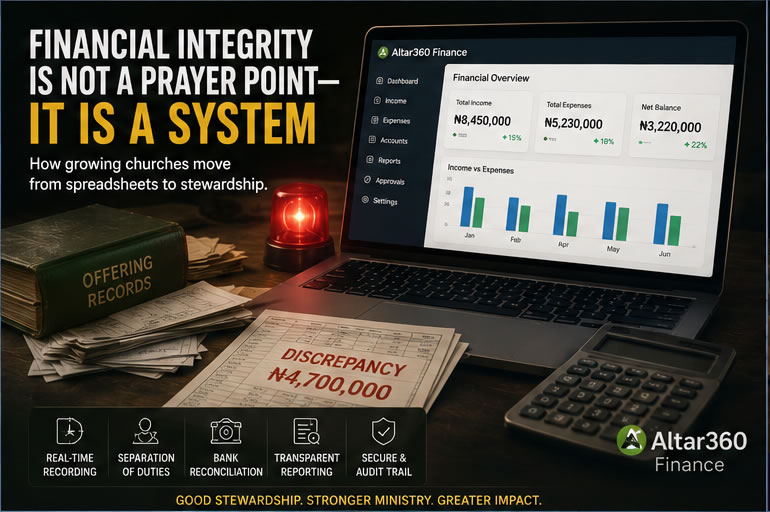
This is the exact problem Altar360's giving system was built to solve — not by replacing the human relationships involved in giving, but by making every step of the process visible, traceable, and accountable to everyone who should be able to see it.
Here's how it actually works:
Bank transfer is treated as the primary giving method, not an afterthought. Given how giving actually happens across African churches, Altar360 puts direct bank transfer front and center — with clear account details, quick preset amounts, and a simple copy-to-clipboard flow — while card payment via Paystack remains available as a secondary option for those who prefer it.
Every transaction creates a real record, immediately. The moment a transfer is made, it doesn't sit in limbo waiting for someone to notice a bank alert. A transaction record is created in the system right away, tied to the giver's details and the category of giving — tithe, offering, building fund, or whatever categories a church has configured.
The right people are notified automatically, not eventually. When a transfer comes in, the Finance Officer is notified so they can confirm it against the actual bank statement. Once confirmed, the General Overseer, the Pastor, and Super Admin are all notified that the transaction is verified — a chain of visibility that happens without anyone needing to ask, call, or chase.
The giver gets closure too, not just leadership. After giving, the person sees a thank-you confirmation and a reference tied to their transaction — so giving doesn't feel like sending money into a void and hoping it was received.
Nothing is summarized away — leadership can always trace back to source. Instead of a single end-of-month total, a pastor or General Overseer can see the actual pattern of giving — by category, by date, by method — with every entry traceable to an individual, confirmed transaction.
The finance officer's job gets easier, not just monitored. Rather than manually reconciling scattered bank alerts against a paper ledger, the finance officer works from a live dashboard showing exactly what's pending confirmation and what's already verified — reducing the room for honest human error, not just watching for dishonest ones.
Why This Matters Beyond the Numbers
There's a deeper effect here that goes beyond bookkeeping accuracy. When giving is visible and traceable — when a member can trust that their transfer was received and recorded, when a finance officer isn't drowning in manual reconciliation, when a General Overseer can see real patterns instead of a single opaque total — something shifts in the culture of the church itself. Giving stops being an act of blind trust and becomes an act of confident participation. And confident givers, over time, tend to give more freely, not less.
This also protects the people doing the work. A finance officer operating inside a transparent, automated system isn't personally exposed to suspicion the way someone managing everything manually inevitably is — the system itself is the record, not any one person's word.
Try It With Your Own Church
Altar360 is Africa's first AI-powered Church Operating System, built around how African churches actually manage giving — bank-transfer-first, Naira-native, with a full notification chain connecting givers, finance officers, and leadership. It's one part of a broader platform that also covers member management, department accountability, visitor follow-up, and pastoral care.
You don't need to take this on faith. Altar360 offers a full 30-day free trial, no card required. Run a real Sunday's giving through it, and see what it feels like when every transaction has a clear, confirmed trail — for the giver, the finance officer, and the leadership alike.
Start your free 30-day trial: https://www.altar360.com