
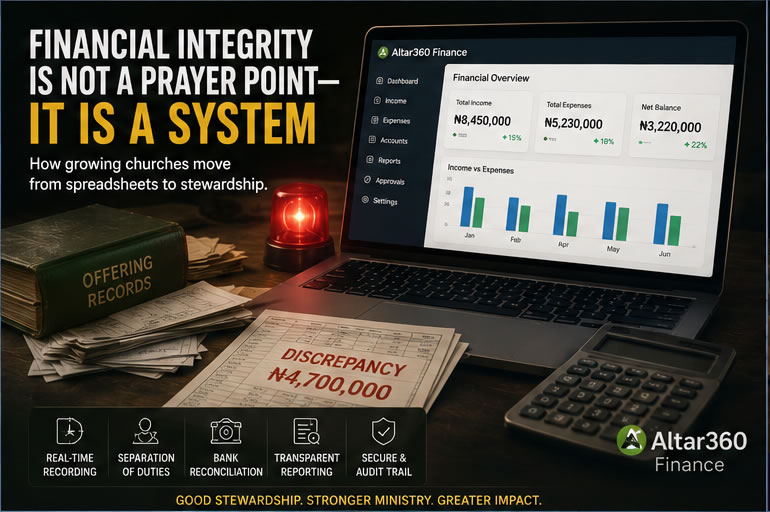
In December 2022, a church in Lagos with over 800 members discovered that their financial secretary had been embezzling funds for 14 months.
The amount? Over ₦4.7 million.
The method? Adjusting cells in an Excel spreadsheet that nobody else had access to or reviewed regularly. The discrepancy was only discovered when a new assistant noticed that the figures reported to the pastor every Sunday did not match the amounts recorded by the counting team after service.
This is not an isolated story. Across Nigeria, in churches of every size and denomination, versions of this story play out repeatedly — sometimes through theft, sometimes through honest error, sometimes through simple incompetence — and the common thread in almost every case is the same: the church was managing significant financial resources through tools designed for personal use.
Excel is not a church accounting system. It was never designed to be one. And the consequences of using it as one range from administrative chaos to financial fraud to legal liability to the destruction of a pastor's reputation and a congregation's trust.
THE SCALE OF THE PROBLEM
Before we discuss solutions, it is important to understand the actual scale of what Nigerian churches are managing.
A church with 500 members in Lagos, at an average tithe of ₦5,000 per person per month, has a monthly tithe income of ₦2.5 million. Add Sunday offerings, midweek offerings, thanksgiving, special projects, building funds, missions giving, and dedicated events — and a mid-sized Nigerian church may be handling between ₦5 million and ₦20 million per month.
That is the equivalent of managing a small business. In some cases, a medium-sized business.
Yet the majority of these churches are managing these funds with a cash counting team that works without a counter-check system, a finance secretary who enters figures into Excel at home on their personal laptop, a pastor who receives a verbal or WhatsApp report of "what came in" every Sunday, a treasurer who reconciles the accounts quarterly at best, and no audit trail, no access controls, no separation of duties.
Every accountant and every forensic investigator will tell you the same thing: this system is not just inefficient. It is a structure that makes financial misconduct almost inevitable.
THE FIVE FINANCIAL RISKS EVERY CHURCH LEADER MUST UNDERSTAND
Risk 1: There Is No Audit Trail
In a proper accounting system, every transaction leaves a trace. Who entered it. When. What amount. What account. Whether it was verified. Whether it was approved.
In Excel, a cell can be changed, deleted, or formatted to show a different figure — and unless someone is actively watching and comparing, there is no record that the change was ever made. This is the mechanism by which most church financial misconduct occurs.
Risk 2: One Person Controls Everything
Good financial management requires separation of duties. The person who counts the offering should not be the person who records it. The person who records it should not be the person who approves payments from it.
In most Nigerian churches, the "finance secretary" or "treasurer" does all of these things. This is not a character failure on the part of these servants. It is a structural failure on the part of the church that put one person in a position that no one person should ever be in alone.
Risk 3: Nobody Knows the Real Financial Picture
Ask the average Nigerian pastor: "What is your church's net balance this month after all income and expenses?" Most cannot answer in less than a week — and the answer they eventually produce is often approximate.
A pastor who does not know the financial position of their church cannot make sound decisions about staffing, programmes, building projects, missions giving, or any other area that involves money. And in a church, that is almost every area.
Risk 4: Excel Errors Compound Silently
A misplaced decimal point. A formula that was accidentally overwritten. A row that was accidentally deleted. These are not dramatic events. They happen quietly, and they can take months to discover — especially when nobody is actively reconciling the books against bank statements.
One church in Ibadan discovered a cumulative error of ₦2.3 million in their annual accounts — not through theft, but through a series of small data entry mistakes that had propagated across linked spreadsheets for eight months before anyone compared the Excel totals to the actual bank balances.
Risk 5: You Are Legally Exposed
Nigerian churches are subject to CAC, SCUML, and NDPA requirements. Each of these requires proper financial record-keeping. Excel spreadsheets stored on a personal laptop, with no access controls, no backup system, and no audit trail, do not meet the documentation standards that regulators require.
WHAT PROPER CHURCH FINANCIAL MANAGEMENT LOOKS LIKE
The principles of good church financial management are not complex. They are the same principles that any well-run small organisation follows.
Principle 1: Separation of Duties
At minimum, your church should have three people involved in every financial transaction — someone who handles the physical money, someone who records the transaction, and someone who reviews and approves the record. These should be different people.
Principle 2: Real-Time Recording
Every transaction should be entered into your financial system on the day it occurs — not accumulated across the week and entered on Friday. Real-time recording prevents the accumulation of errors and ensures that the financial picture you are seeing is accurate to today, not to last month.
Principle 3: Bank Reconciliation
Every month, without exception, your recorded income and expenses should be compared against your actual bank statements. Discrepancies should be investigated and resolved before the next month begins.
Principle 4: Transparent Reporting
Your church leadership should receive a complete financial report every month. Not a verbal summary. A written report that shows income by category, expenses by category, balance carried forward, and comparison against the previous month and against budget.
Principle 5: Documented Approval for Every Payment
No money should leave the church account without documented approval from at least two authorised signatories. "The pastor said it was okay" is not documentation. A signed payment authorisation form is documentation.
A STORY WORTH HEARING
Pastor Bola Adesanya planted Victory Outreach Church in Akure in 2016. In the early years, he handled everything himself — the preaching, the counselling, the administration, and the finances. "I was the pastor, the secretary, and the treasurer," he says. "I thought I was serving God. I was actually creating a system that could destroy everything God was building."
In 2020, a new member joined the church — a chartered accountant named Mr. Adeyemi. Within three months of reviewing the church's financial records, Mr. Adeyemi identified ₦890,000 in unreconciled discrepancies, three offering categories that had never been reported to the leadership, and a pattern of "miscellaneous expenses" that had no supporting documentation.
There was no evidence of deliberate fraud. But there was abundant evidence of a system so disorganised that fraud would have been undetectable even if it had occurred.
"The day Mr. Adeyemi showed me that report," Pastor Bola told me, "I understood for the first time what financial stewardship actually means. It is not about being honest. It is about creating systems that make honesty verifiable."
Victory Outreach Church now uses a proper church management system with a dedicated finance module. Every offering is entered at the point of counting, verified by two people, approved by the finance committee, and reconcilable against the bank statement at any moment.
"We did not just build a building," Pastor Bola says. "We built trust."
THE ALTAR360 FINANCE MODULE
Altar360's finance module was built specifically for the Nigerian church context. It allows finance teams to record offerings by category in real time, track expenses with full documentation and approval workflows, manage multiple accounts and reconcile automatically, generate income vs expense reports and balance sheets, control access by role, and export clean financial reports for CAC annual returns or board review.
The goal is simple: to give every Nigerian church the financial management infrastructure that makes integrity not just a virtue but a verifiable reality.
Because financial integrity is not a luxury. It is the foundation on which the credibility of every other ministry is built.
Start managing your church finances properly. Altar360's 14-day free trial is available at altar360.com — no credit card required.
