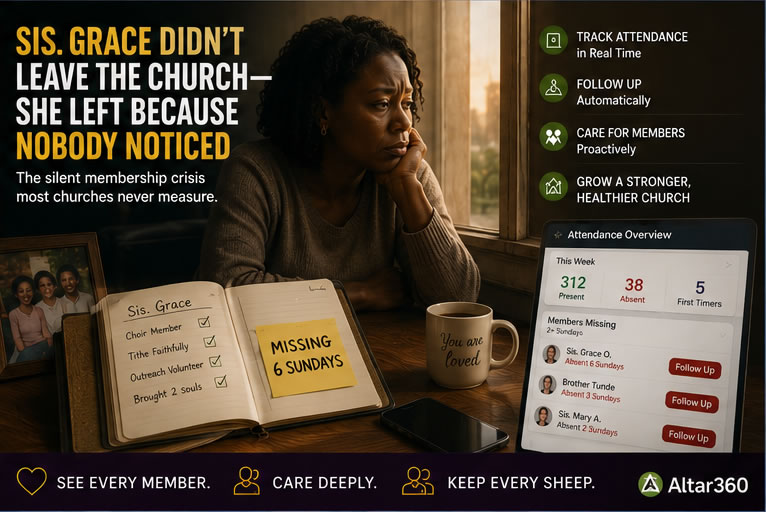

It happens quietly, almost always with good intentions on every side. A member approaches their pastor after service, visibly carrying something heavy — a marriage in trouble, a grief still raw, a season of struggle they've finally found the courage to name out loud. The pastor listens, prays with them, promises to check in. It's a real, meaningful moment.
And then the week moves on. Another crisis needs attention. Another service needs preparing. Another department needs a decision. The promise to follow up was genuine — but it lived only in the pastor's memory, and memory, however well-intentioned, has limits when there are dozens of people, each carrying their own version of that same conversation.
Weeks later, that member is still carrying the same weight, quietly wondering whether anyone actually remembered — or whether the moment they opened up simply got lost among everything else the church had going on.
Why This Gap Is So Easy to Miss
Pastoral care doesn't fail because pastors don't care. It fails because care, without structure, depends entirely on the limits of one person's attention and memory — and church leaders are, by the nature of the role, being asked to hold an enormous number of people's stories in their heads at once.
Multiply one missed follow-up by every counselling conversation, every bereavement, every marital crisis, every prayer request whispered after a service — across months and years — and the gap becomes significant, even though no single moment feels like a failure. It's not any one pastor's fault. It's the absence of a system that was ever built specifically for this kind of care, as opposed to general church administration.
There's also a quieter cost: when care depends entirely on one person's memory, it can't be shared. If a counselling relationship needs a second pastor to step in — because of travel, illness, or simply because a different perspective would help — there's often no record of what's already been discussed, what progress has been made, what's already been tried.
What Structured Pastoral Care Actually Looks Like
This is precisely why Altar360 was built with real pastoral care infrastructure — not just membership records, but a genuine system for the sensitive, ongoing work of counselling, prayer, and crisis support.
Here's how it functions in practice:
Every counselling relationship becomes a real, trackable case — not a memory. When someone opens up, a case can be opened: marital counselling, bereavement support, conflict resolution, or general pastoral counselling. That case has a clear status — open, in progress, closed — so nothing simply fades into uncertainty.
Private notes stay private, but they don't disappear. Sessions can be logged with confidential notes attached to the case, meaning the details of what's been discussed and what progress has been made exist somewhere secure — not only in one pastor's memory, vulnerable to being forgotten during a busy season.
Continuity survives a change in who's helping. If a different pastor or counsellor needs to step in — because the original pastor is traveling, or because the situation calls for a different kind of support — they're not starting from zero. The history is there, respectfully and securely, so the person being cared for doesn't have to re-explain their situation from the beginning.
Prayer requests become a real ministry chain, not just a kind gesture. A prayer request can be assigned to a specific prayer partner and tracked through to follow-up, so "I'll be praying for you" is backed by an actual system ensuring someone follows through — rather than good intentions that quietly don't happen amid a busy week.
Leadership can see the pattern, without invading anyone's privacy. A pastor or General Overseer can see how many cases are open, how many have gone unattended for too long, and where the pastoral care team might be stretched thin — without seeing private session notes themselves unless they're the one directly involved in that case.
What This Changes, Quietly But Deeply
The value here isn't operational efficiency in the way a finance or attendance system is. It's something more personal: it's the difference between a member feeling like their pain was heard once and then forgotten, and a member feeling like their church genuinely holds their situation with care over time.
For pastors, it also relieves a real, often invisible burden — the quiet guilt of knowing there's someone you meant to call back and didn't, because there were simply too many people and too little memory to hold them all. A system that remembers on your behalf doesn't replace pastoral care. It protects your ability to actually deliver it, consistently, to everyone who needs it — not just the person whose situation happened to stay top of mind.
Try It With Your Own Church
Altar360 is Africa's first AI-powered Church Operating System, built around the full scope of how African churches actually care for their people — not just membership and finance, but the sacred, sensitive work of counselling, prayer, and pastoral follow-up. It's part of a broader platform that also covers department accountability, transparent giving, visitor follow-up, and branch management.
You don't need to take this on faith. Altar360 offers a full 30-day free trial, no card required. See what it feels like to know that when someone in your church opens up, nothing about their care depends on memory alone.
Start your free 30-day trial: https://www.altar360.com